Send conversions back to Facebook
This scenario sets up server-side conversion sending (CAPI): when a registration or deposit happens on your side, Qubix reports it straight to Facebook's server, so its algorithms optimize on real events. Unlike the browser pixel, server-side sending is not lost to blockers — for the why, see FB CAPI.
What you need beforehand: a Facebook pixel and its access token (created in Facebook), and a campaign you drive traffic to.
1. Add the pixel and its token
Open the Facebook section, go to the Pixels tab and click + Add pixel. Enter a Name, the Pixel ID and paste the Pixel access token, then click Validate and Save. For more — see Pixels.
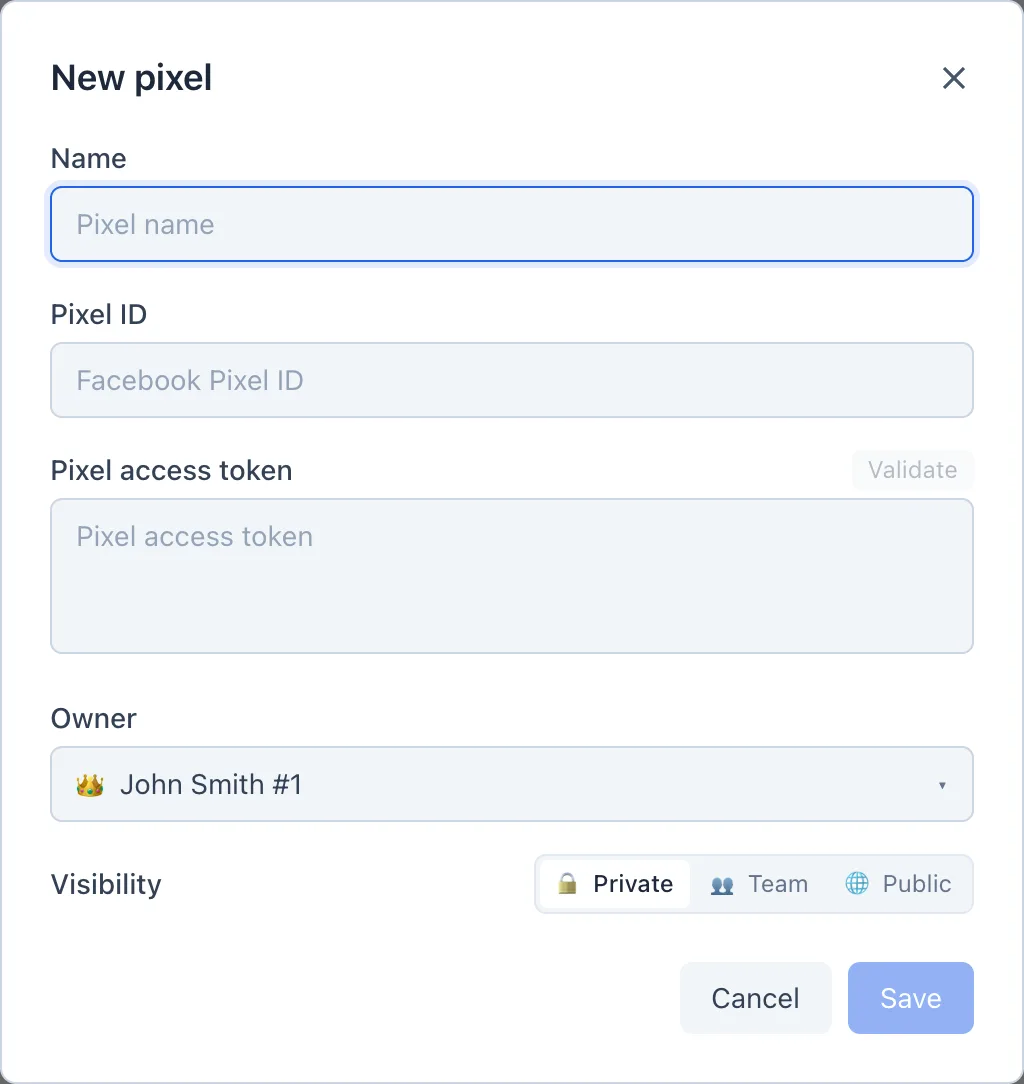
Always click Validate first — a green checkmark means Facebook accepted the token, so the pixel will really receive events instead of failing later on live traffic.
2. Create a Facebook source with CAPI mapping
Open Sources and click + Add source. In the From template field choose facebook — this replaces the regular postback with a Conversions API block. There you map "Qubix event → Facebook event" (for example, deposit → Purchase). The pixel is taken from the click link, and the token — from the pixel registry. Click Create. For more — see Creating a source and Parameter passing and postback.
3. Carry the pixel in the ad link
In the campaign, choose this Facebook source on the Settings tab and add an Entry point. In the Example URL for an ad block the pixel value is a clickable hint — click it and pick your pixel from the list, so it is substituted into the link. Then click Copy and paste the link into the ad. For more — see Campaign link and parameters.

4. Watch for send failures
Server-side sending has no screen of its own — it works in the background. If an event fails to reach Facebook, an alert arrives in Telegram for subscribers of the Conversion send failures role. Subscribe to it in Notifications, and tune how often the alert repeats in Connections → Telegram.
Done
Conversions now flow back to Facebook server-side, and you are alerted if any fail to send. Next: